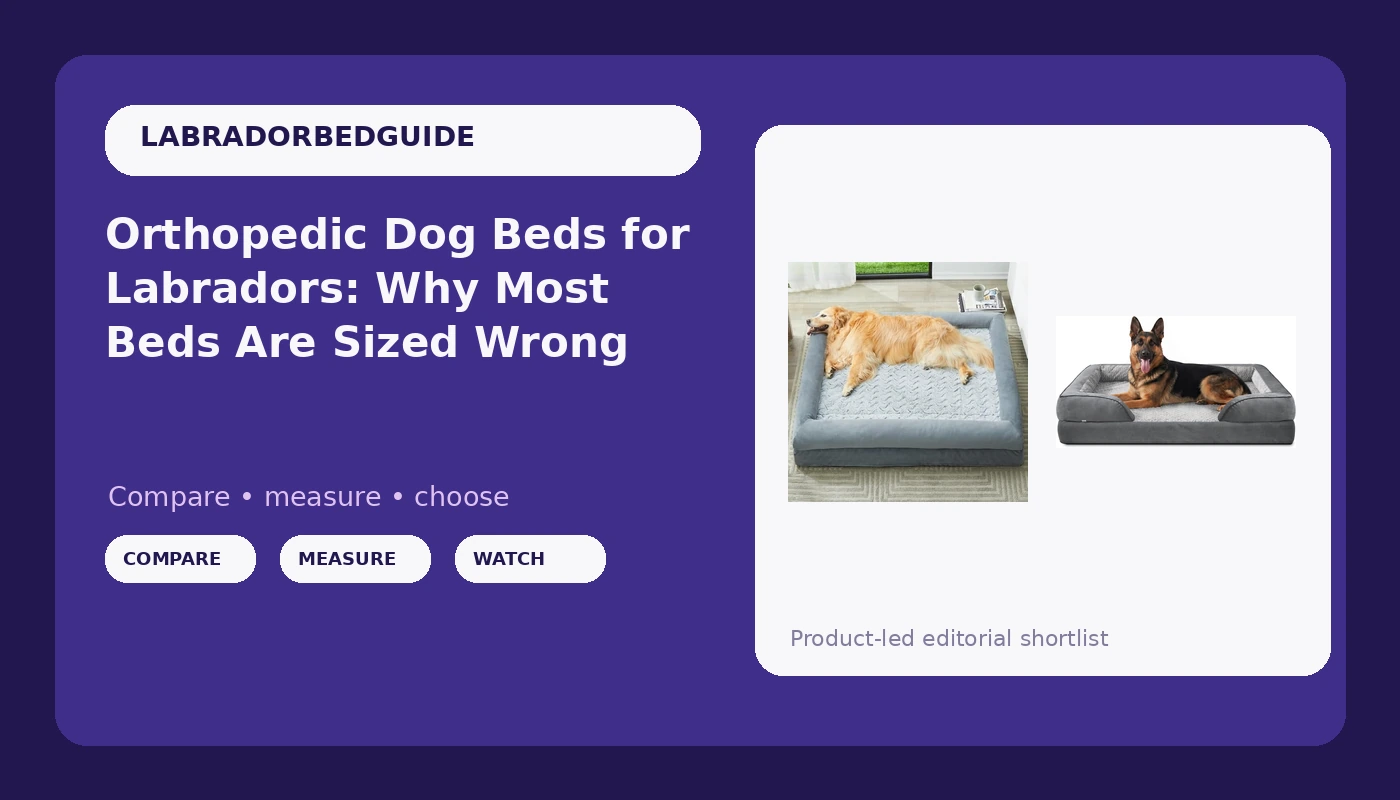
Most beds sold for labradors are sized for a 40-pound dog and stuffed with foam that pancakes before the dog's second birthday. If you want an orthopedic dog bed for a Labrador that is still holding its shape two winters from now, you have to shop on different numbers than the person buying a bed for a cocker spaniel.
I'm Mike. I trained labs for a decade before I started writing about gear full time, and there are two of them asleep behind me while I type this. Duke is a 75-pound black lab who chews first and asks questions later. Penny is an 11-year-old rescue with hip dysplasia, and she has taught me more about foam than any product label ever did, mostly by the way she gets up on a cold morning.
What follows is the process I run before any bed comes into this house: how to measure, what foam number to demand, how to read a cover spec, and how to set the bed up so your lab actually uses it. Two beds made the shortlist, one built for a senior with bad hips and one built for a calm older dog who mostly wants to be comfortable.
Why you should trust me
I've put more than 40 beds under my own dogs and under the kennel dogs I trained with, and I keep a notebook on every one: purchase date, foam sink depth measured with a ruler, and the week it failed. That notebook is why I stopped believing the word "indestructible" on a cardboard tag.
Duke has destroyed beds that cost more than my first truck. He has also ignored the right beds for years at a time, and the difference was never luck. It came down to fabric, stitching, and whether the foam was dense enough to hold 75 pounds without folding into a bowl.
My vet, Dr. Alvarez, told me she sees more joint problems in labs than in any other breed she treats. That matches what I see in my own two. Labs carry serious weight on hips that were bred for retrieving, not for sleeping on 1.5-pound foam. So I judge a bed on two things only: whether it survives the dog, and whether it supports the dog.
How I picked and how I tested
Every bed gets the same seven-item checklist before it earns floor space.
Honest size comes first. I measure the dog nose to tail, add 12 inches, and compare that to the sleeping surface the listing actually gives you. Labs sprawl like starfish, they do not curl up like donuts, so a bed sized for a curled dog leaves elbows hanging off the edge all night.
Foam is second. Memory foam is measured in pounds per cubic foot, and the cheap material runs 1.5 to 2. I want 3 to 4 for a lab. Egg-crate foam is a different animal: the peaks and valleys spread pressure and let air move, which is genuinely useful for a dog with sore hips, but it is not the same thing as a solid slab of dense foam. A listing that says "orthopedic" without a density number is selling you a word, not a measurement.
Third is the cover, and removable plus machine washable is the floor, not a luxury. Fourth is the zipper, which is the first part to die on any bed I've owned, usually around wash twenty. Fifth is a waterproof lining, which matters more than most people admit once a dog passes ten years old. Sixth is a nonskid bottom, because a bed that slides across hardwood every time the dog stands up is a bed the dog quits using.
Seventh is cost per usable day, which is price divided by the number of days the bed actually lasts. I'll come back to that at the end, because it is the only honest way to compare two beds.
I judged the two beds below against that same checklist using the specifications each listing publishes, and I'll tell you where each one wins and where each one worries me. I'm not going to pretend a waterproof lining is the same thing as a chew-proof cover, because it is not, and Duke would prove it in an afternoon.
Beds worth putting under a Labrador
Both of these are XXL orthopedic beds aimed at older dogs, which is the right target for most lab households. Neither is a bed I would hand to someone with a nine-month-old land shark.
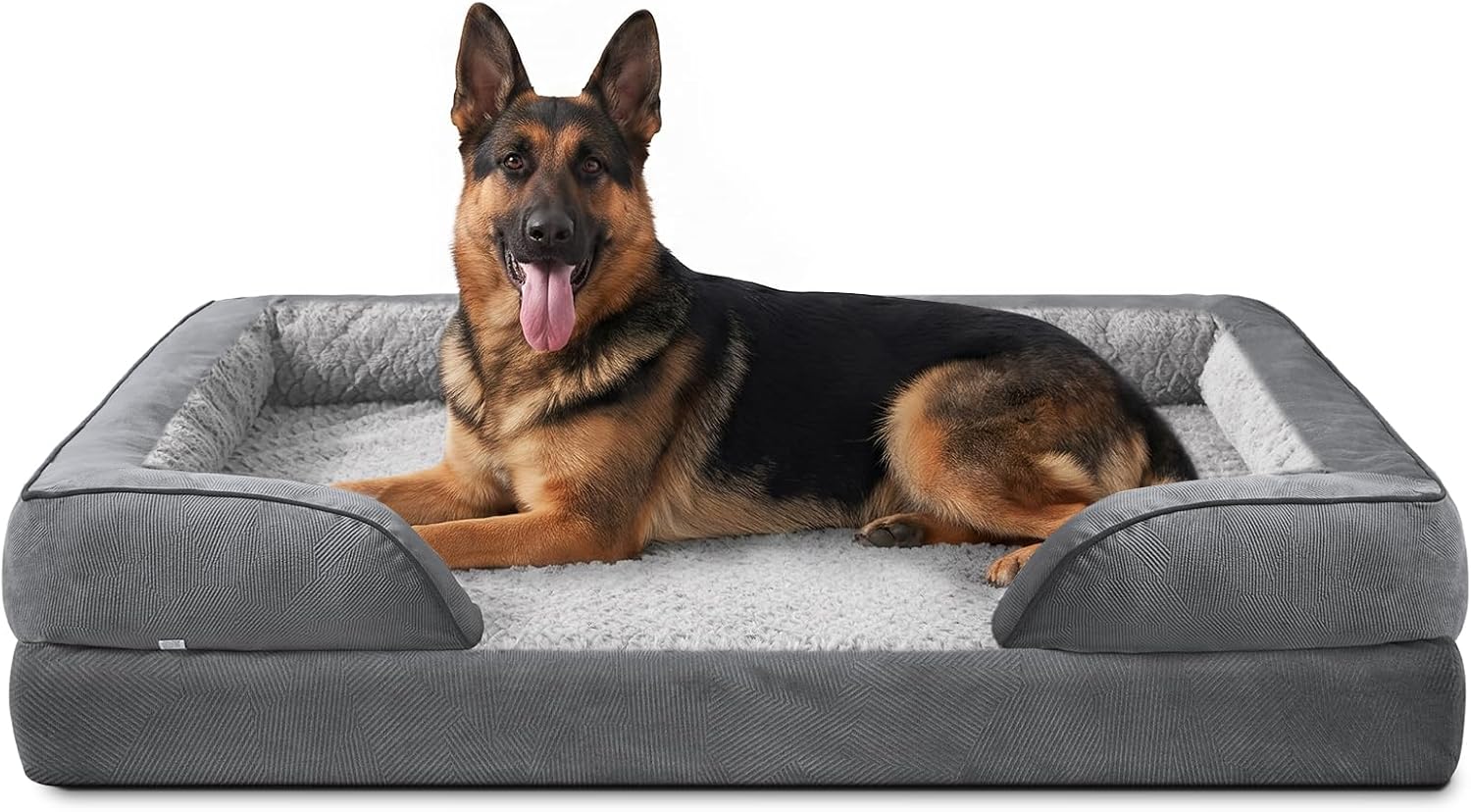
Our pick for a lab with bad hips: INVENHO Orthopedic Extra Large Dog Bed, XXL Waterproof Dog Sofa, Egg-Crate Foam Couch with Washable Removable Cover, Waterproof Lining and Nonskid Bottom
 Visit on Amazon →
If your lab is starting to hesitate at the bottom of the stairs, this is the one I would put in front of you first. Egg-crate foam over an XXL footprint is the right combination for a dog with hip dysplasia, because the egg crate spreads pressure across the whole hip instead of concentrating it under one point, and the size means a big dog can stretch out flat instead of sleeping half on the floor.
Three details on the spec sheet earn it the top spot. The cover is removable and washable, which is non-negotiable in a house with an older lab. The lining underneath is waterproof, which protects the foam from the accidents that start happening around age eleven. And the bottom is nonskid, which keeps a 55-pound dog from pushing the whole bed into the wall every time she stands up.
The caveats are the same ones I give everyone. Egg-crate foam is softer than a solid slab, so if your lab is a 90-pound male who flops down like a dropped sack of feed, expect the peaks to compress over time and check the sink depth with a ruler every few months. A waterproof lining also means less airflow through the foam, so wash that cover on a schedule instead of waiting for it to smell. And if your lab is under three years old, none of this matters, because he will open the cover like a wrapped present.
Check current Amazon price before you commit, and measure your dog first.
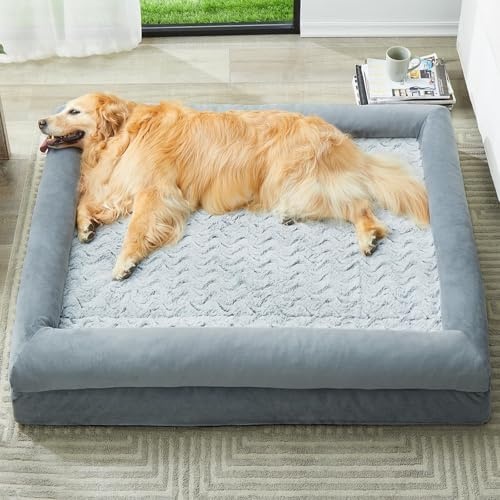
Runner-up for a calm senior: WNPETHOME XXL Extra Large Orthopedic for Senior Dog BedComfy Sleeping
 Visit on Amazon →
This is the softer of the two, and the name tells you exactly who it is for: a senior dog whose main job is sleeping. If you have a twelve-year-old lab who curls into a loose ball for sixteen hours a day and has not chewed anything since the last presidential administration, the plush feel here is a feature, not a flaw.
The XXL sizing is the part I care about most. It gives a full-grown lab room to stretch, which is the entire reason I keep telling people to ignore the word "large" on a dog bed box. It is orthopedic, it is built for seniors, and the comfy sleeping angle means the top surface is gentler on elbows and pressure points than a firm slab.
Here is the honest caveat, and it is the one that gets people in trouble. Comfy sleeping usually means a plush or bolstered surface, and plush is a chew toy with a price tag for a lab under three. Duke would have eaten this bed in a week when he was two. He is five now and calmer, but I still would not leave him alone with a soft-topped bed for an afternoon until I knew his habits.
So buy this one for the dog who has already proven he can be trusted with soft things, and buy the firmer bed above for the dog who has not.
Check current Amazon price on both before you decide, because the gap between them is smaller than most people guess.
The actual sizing and setup workflow
This is the part you came for. Run these steps in order and you will not waste money on a bed your lab refuses to use.
Step one: measure the dog, not the corner. Put your lab on the floor, stretch a tape from the tip of his nose to the base of his tail, and write the number down. Add 12 inches. That is your minimum sleeping surface. A 75-pound male lab usually measures 36 to 40 inches nose to tail, which puts the floor at roughly four feet of bed. This is why "large" beds fail labs, and why XXL is not overkill for this breed.
Step two: decide what you are actually buying for. Age drives the answer. Under three years old, you are buying durability, and the smart move is a cheap bed plus more chew toys, because the shark phase ends and the expensive foam does not need to be part of the lesson. Three to eight years old, you are buying durability and support together. Eight and up, comfort and joint support beat everything else, and you should be willing to pay for foam that holds its shape.
Step three: get the foam number. Ask what the density is in pounds per cubic foot. If nobody can tell you, assume 1.5 and price it accordingly. For a lab, 3 to 4 is the target, and anything under 2 will pancake under a full-grown male within a year.
Step four: read the cover spec like a contract. You want removable, machine washable, and a zipper with some substance to it. Run your thumbnail along the zipper teeth. If it feels like the zipper on a cheap duffel bag, it will die around wash twenty, and a bed with a dead zipper is a bed you cannot clean.
Step five: check the bottom and the lining. Nonskid bottom for hardwood and tile. Waterproof lining if your dog is old, incontinent, or a heavy drooler. Both of the beds above have the nonskid base, and the INVENHO adds the waterproof lining.
Step six: set the bed up where the dog already sleeps. Do not put it in the corner you like. Put it where he already chooses to lie down, then move it six inches at a time if you want it somewhere else. Dogs pick spots based on sight lines and drafts, and a bed in a drafty hallway is a bed that stays empty.
Step seven: redirect the chewing, then stop worrying about it. A puppy chewing a bed is not being bad, he is being a puppy. Make the bed boring and the chew toy interesting, and rotate the toys so they stay novel. If your lab is past three and still opening beds, the problem is not the bed, it is the fabric, and no amount of training beats a determined jaw.
Step eight: maintain it on a schedule. Wash the cover every two to three weeks, or weekly if your dog drools heavily or has accidents. Flip or rotate the foam monthly so it wears evenly. Every three months, press a ruler into the foam next to your dog's favorite spot. If it sinks more than an inch and a half and stays there, the foam is done and you are now the owner of a pancake.
The competition and why it lost
K9 Ballistics is the bed I recommend to anyone with a lab under three, and it is the only bed Duke has not destroyed in fourteen months of trying. It is not in this guide because it is a different purchase: you buy it for the chewing, not for the hips.
The Big Barker is the bed I recommend for a senior lab when budget is not the constraint. The foam is the densest I have measured, and Penny's morning limping improved measurably on it. It is not here because this guide is about two beds at a much friendlier price point, and not every household wants to spend senior-dog money on a bed.
Orvis makes the best covers I have washed, and the foam inside is mediocre, which makes it a strange pick for a dog with joint problems. BarkBox beds are fine for dogs who do not chew, and I have read enough "lasted a week" reviews to know which dogs those are.
Donut beds do not belong in this conversation at all. A 75-pound lab does not curl up. He sprawls like a starfish, and a donut bed gives him a wall to drape his chin over and nothing else.
What this all costs
The only number that matters is cost per usable day: what you paid divided by how many days the bed actually lasted. A cheap bed that dies in four months is more expensive per day than a good bed that runs three years, and that is arithmetic, not opinion.
The mistake every lab owner makes once is buying a soft, cheap bed for a puppy and watching it get gutted in a week. Consider that money tuition. The lesson is that the dog's age, not the sale price, decides what you should buy.
If your lab is under three, spend the money on chew toys and a basic durable bed, and wait. If your lab is a senior with sore hips, spend it on foam, and the two beds above are where I would start. If your lab is somewhere in the middle, buy the firmer one and accept that comfort is second to survival for a few more years.
That is the whole job. Measure the dog, demand the foam number, check the zipper, and stop buying beds that were designed for a dog half his size.