If you have ever bought a bed labeled "large" and then watched your Labrador hang off both ends of it, you already know why shopping for orthopedic dog beds for Labrador retrievers is confusing. Labs do not sleep the way the marketing photos suggest. They sprawl flat, legs out, taking up more floor than the bed's footprint allows. Add a heavy frame, a chewer's jaw, and hips that get stiffer every winter, and the label on the box stops meaning much.
This explainer is not a ranking. It is a walk through four beds currently listed on Amazon, what each one is actually built for, and the questions that decide whether you end up with a bed your lab uses for years or a pancake you drag to the curb in four months.
Related: How to Measure Your Labrador for a Dog Bed →
Quick answer
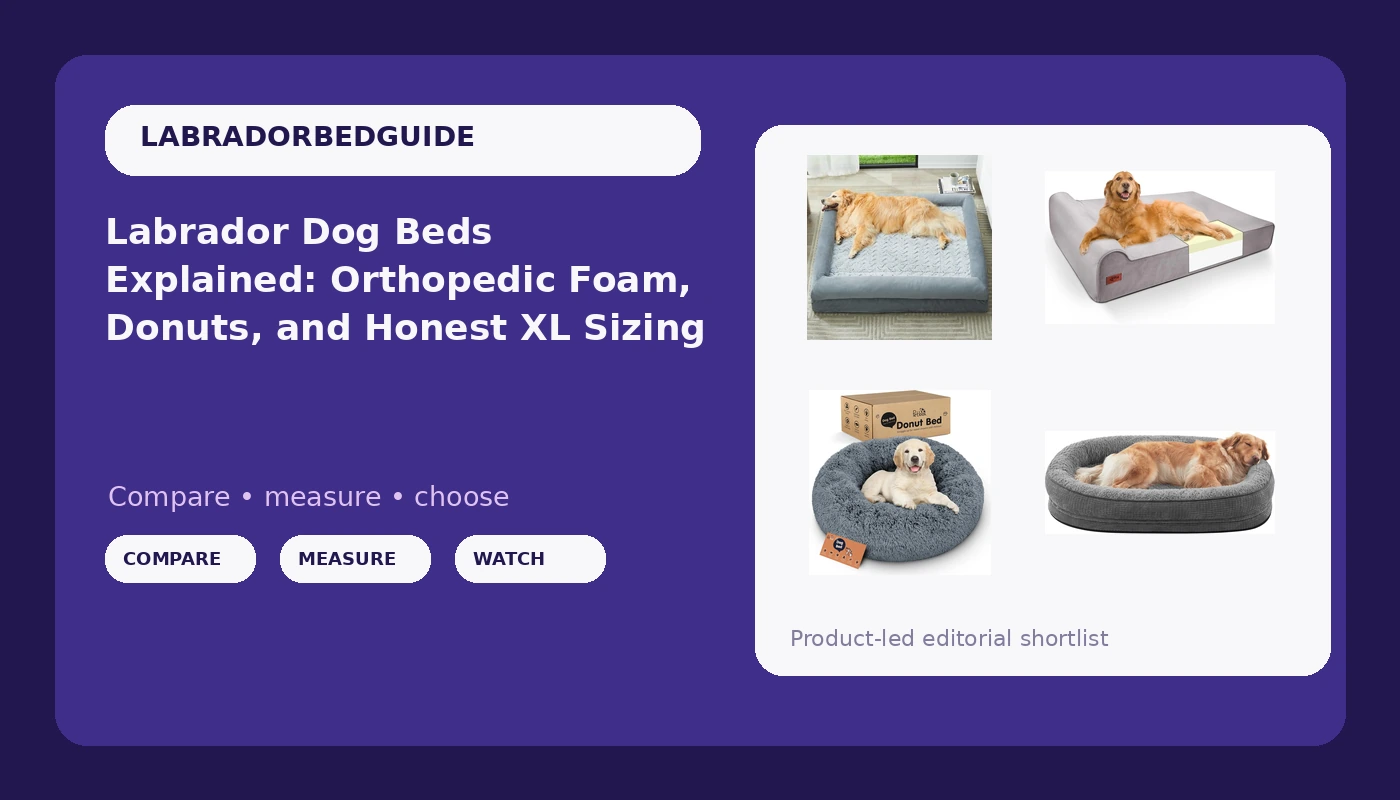
For most adult Labs, the deciding factors are foam thickness, an honest XXL footprint, and a cover you can pull off and wash. The Sytopia XXL 35D memory foam bed is the one built around big dogs, listed for animals up to 150 pounds with a 7-inch foam layer and a waterproof liner. The WNPETHOME XXL is positioned for senior dogs and flat sleepers. The JOEJOY XL is the egg-crate foam option with bolster sides. The Calming Donut is a round bed listed for small dogs and also for medium and large dogs that curl, which is not how most Labs sleep.
Four useful options
| Model | Best fit | What stands out |
|---|---|---|
| WNPETHOME XXL Extra Large Orthopedic for Senior Dog BedComfy Sleeping | Senior Labs who sleep stretched out | XXL orthopedic build marketed for senior dogs |
| Sytopia XXL 35D Memory Foam Dog Bed for Extra Large Dogs, 7" Thick Orthopedic Pet Couch for Seniors and Big Breeds up to 150 Pounds, with Waterproof Liner & Washable Cover, Nonskid Bottom, Grey | Big breeds carrying serious weight | 7-inch 35D memory foam, waterproof liner, washable cover, nonskid bottom |
| Calming Donut Dog Bed for Small Dogs, Round Dog Bed for Medium & Large Dogs | Dogs that curl into a ball | Round donut shape with a raised rim |
| JOEJOY Orthopedic Dog Beds Large Sized Dog, XL Egg-Crate Memory Foam Pet Couch Bed with Bolster Sides, Waterproof Lining, Removable Washable Cover & Non-Slip Bottom, Grey | XL dogs that like a side to lean against | Egg-crate memory foam, bolster sides, waterproof lining, removable cover |
The senior sprawler: WNPETHOME XXL Extra Large Orthopedic for Senior Dog BedComfy Sleeping
The reason I point senior owners here first is simple: an older Lab does not want to climb into a nest. Penny is eleven and carries hip dysplasia, and the thing she needs is a wide, flat landing pad she can walk onto without a step up. A bed marketed for seniors usually means a lower profile and a bigger flat area, which matches how an arthritic lab actually lies down.
The trade-off is the same one you get with most flat orthopedic beds. There is no bolster to lean against, and there is no chew-proof claim anywhere on it. If your Lab is under three and still in the shark phase, this is a comfort purchase, not a durability one.
The heavy-duty foam: Sytopia XXL 35D Memory Foam Dog Bed
Thickness is the number that matters most here. A 7-inch foam layer is a lot of foam, and the 35D figure in the name refers to the density rating the listing uses. Density is what separates a bed that holds its shape from a bed that turns into a pancake under a 75-pound dog. Duke is right at that weight, and a Lab that size compresses cheap foam into a permanent dent within a season.
The waterproof liner and removable cover are the two features I check before anything else on a bed this size, because a large bed is a large thing to wash. A nonskid bottom matters on hard floors when a dog pushes off to stand up. The caveat is that a couch-style bed with this much foam is a bigger footprint in your living room, and no foam on the market is chew-proof against a determined two-year-old Lab.
The curl-up donut: Calming Donut Dog Bed
I will be direct about this one, because it is the bed most Labrador owners buy by mistake. A donut bed is designed for a dog that curls up nose to tail. A Lab sprawls like a starfish. Buy a round bed for a 75-pound Lab and you have paid for floor space the dog cannot use, with his head hanging over the rim.
Where this bed earns its place is in a multi-dog house. If you have a smaller dog, or a Lab that genuinely tucks into a ball on the couch, a round bed does what a flat orthopedic bed cannot: it gives the dog a rim to press against. Read the size listing carefully, since "medium and large" on a round bed is a very different footprint from "XXL" on a flat one.
The bolster option: JOEJOY Orthopedic Dog Bed XL
Egg-crate foam is a different animal from a solid slab. The convoluted surface spreads pressure and lets air move, which many dogs find comfortable, but it does not have the same load-bearing density as a thick solid memory foam layer. For a Lab that likes to rest his chin on a raised edge, the bolster sides are the real feature here, and they also give a dog something to push against when standing up.
The removable washable cover and waterproof lining are what make an XL bed livable. Mud, drool, and the occasional accident all end up on the cover, not in the foam. If your Lab is a heavy chewer, treat the bolsters as the first casualty: stuffed edges are the part dogs go after.
Prices and availability may change. Product images, names, and retailer links are matched to verified listings. No current price, rating, stock status, or measured result is stated here without current evidence.
Why size math beats bed labels
"Large" on a dog bed listing is close to meaningless. I have measured enough beds to know that a large from one brand can be smaller than a medium from another. The only sizing method that has never failed me is a tape measure and your dog.
Measure your Lab from the tip of his nose to the base of his tail while he is standing. Then add about 12 inches. That extra foot is not padding for comfort, it is the room a sprawler needs when he flops down and throws one leg out sideways. A Lab lying flat is longer than a Lab standing, because the legs go somewhere.
Then measure the floor space you are actually willing to give up. An XXL orthopedic bed is a piece of furniture. If it does not fit in the spot where your dog already sleeps, he will sleep on the couch and the bed becomes a very expensive rug.
Two more sizing traps. First, weight limits on a listing are not the same as fit: a bed rated for 150 pounds can still be too short for a tall Lab. Second, a round or donut bed has a usable area that is smaller than its diameter, because the rim eats the edges. A flat bed of the same diameter gives the dog more usable surface.
Foam, chew timelines, and the senior exception
Memory foam is measured in pounds per cubic foot. Cheap foam sits around 1.5 to 2. Good orthopedic foam runs higher, and the difference shows up as sink depth. Put a 75-pound Lab on low-density foam every night for six months and you get a body-shaped crater. That crater is why the bed ends up in the garage.
Egg-crate foam, solid memory foam, and shredded fill all behave differently. Shredded fill is the worst offender for Labs under three, because the filling is loose, tempting, and easy to pull out through a seam. Solid foam is the most durable shape. Egg-crate sits in between: comfortable, lighter, and less load-bearing.
Here is the order I use to decide:
- Measure your Lab nose to tail, add 12 inches, and write the number down.
- Decide which dog you are buying for: a puppy in the shark phase, an adult chewer, or a senior with stiff hips.
- Check the foam type and thickness, and treat a stated density rating as more useful than a "orthopedic" label.
- Check that the cover comes off and that there is a waterproof liner under it.
- Check the bottom and the size listing, then compare the bed's footprint against the floor space you measured.
Matching the bed to your Lab's age and hips
- Under three years old, assume the bed is temporary. Buy for durability, not for a cloud-like look, and expect to replace it.
- Five to eight years old, weight and foam density matter more than anything else. This is the range where cheap foam dies first.
- Seniors with hip dysplasia need a low, flat entry and thick support, not a deep nest they have to climb into.
- If your Lab sleeps stretched out, choose a flat XXL bed. If he curls, a round bed is not wasted money.
- If your house has hard floors, a nonskid bottom is not a nice extra, it is the difference between a stable bed and a bed that slides when your dog stands up.
Which option should you choose?
Choose the WNPETHOME XXL Extra Large Orthopedic for Senior Dog BedComfy Sleeping when your Lab is older, sleeps flat, and needs a wide low surface to walk onto. Choose the Sytopia XXL 35D Memory Foam Dog Bed for Extra Large Dogs when you want the thickest foam layer in this group and a bed listed for dogs up to 150 pounds. Choose the JOEJOY Orthopedic Dog Beds Large Sized Dog, XL Egg-Crate Memory Foam Pet Couch Bed with Bolster Sides when you want egg-crate foam with raised sides and a cover that comes off for washing. Choose the Calming Donut Dog Bed for Small Dogs, Round Dog Bed for Medium & Large Dogs only if you also have a smaller dog in the house, or if your Lab genuinely curls into a ball.
One caveat before you buy. Everything here comes from the product listings: foam thickness, density ratings, weight limits, and cover details. No current price, rating, or stock status is stated, and no bed survives a determined chewer forever. Durability is decided by your individual dog's jaw, not by a label.
The bottom line
For a Labrador, buy the footprint first and the foam second. Measure nose to tail, add a foot, and pick a bed that gives your dog that space without crowding the room. Then look at foam thickness and density, because that is what keeps the bed off the garage floor after a year of a 75-pound dog lying on it every night. Seniors get the flat, thick, low-entry bed. Curlers get the round one. Puppies get whatever you can afford to lose, because the shark phase always wins.